Estimate a tree’s height from its shadow
Compare two shadows recorded together on level ground, then keep the measurements and their limits in a field note.
Three measurements, one estimate
On a sunny day, a tree and a small upright object can act as measuring guides for each other. Measure the reference object’s height, its shadow and the tree’s shadow. When the conditions below are met, their proportions give an estimate of the tree’s height from the ground to its top.
Bring a tape measure, a notebook, a calculator and a straight reference object that someone can hold vertically with its base on the ground. A handle or ruler will do; measure its actual height. A standing person can also be the reference, using their measured height in the clothing and footwear worn for the activity.
Choose a tree you can measure this way
Look for a fairly isolated, upright tree whose top appears to be above its base. Its whole shadow must fall on clear, level, accessible ground. The reference object must also cast its shadow on this same level ground.
You need to recognise the shadow of the tree’s top, rather than simply the farthest edge made by a side branch. If shadows overlap or you cannot match a shadow tip to the treetop, choose another tree. A narrow outline and a distinct top make the activity easier.
Stay in a quiet area where you are allowed to walk. If measuring would take you across a road, water, a fence or somewhere you cannot walk normally, choose a different subject. Work from the ground, without climbing or looking at the Sun.
Record both shadows at the same time
- Measure h: the vertical distance from the ground to the top of the reference. Keep it upright with its base still. If using a person, maintain an upright posture and identify the shadow of the top of their head.
- Working as a pair, mark both shadow tips almost simultaneously. Use small objects laid on the ground or permitted temporary marks, and remove them afterwards. You can then measure between the fixed points without chasing the moving shadows.
- Measure s: from the reference’s base to its shadow mark. Measure S: from the tree’s base to the mark corresponding to its top, along the shadow’s direction. The theoretical starting point is the trunk’s centre at ground level; estimate its position if bark prevents placing the tape there, and record that uncertainty.
- Use the same unit for h, s and S: for example, convert 80 cm to 0.80 m before calculating. If working alone, record one shadow immediately after the other, then repeat a complete pair: do not combine an old measurement with a new one.
The calculation and why it works
The formula is H = h × S ÷ s. H is the height you want, h the reference height, S the tree’s shadow and s the reference shadow. The value of s must be greater than zero and long enough to measure clearly.
In this model, sunlight arrives in parallel rays. A vertical height and its shadow on horizontal ground form a right triangle. The two triangles have equal corresponding angles, so their corresponding sides are proportional. Thus, H/S = h/s.
This does not mean that height equals shadow length. That equality only applies when the reference and its shadow have the same length. As a quick check, if the tree’s shadow is ten times the reference shadow, the calculated tree height must be ten times the reference height.
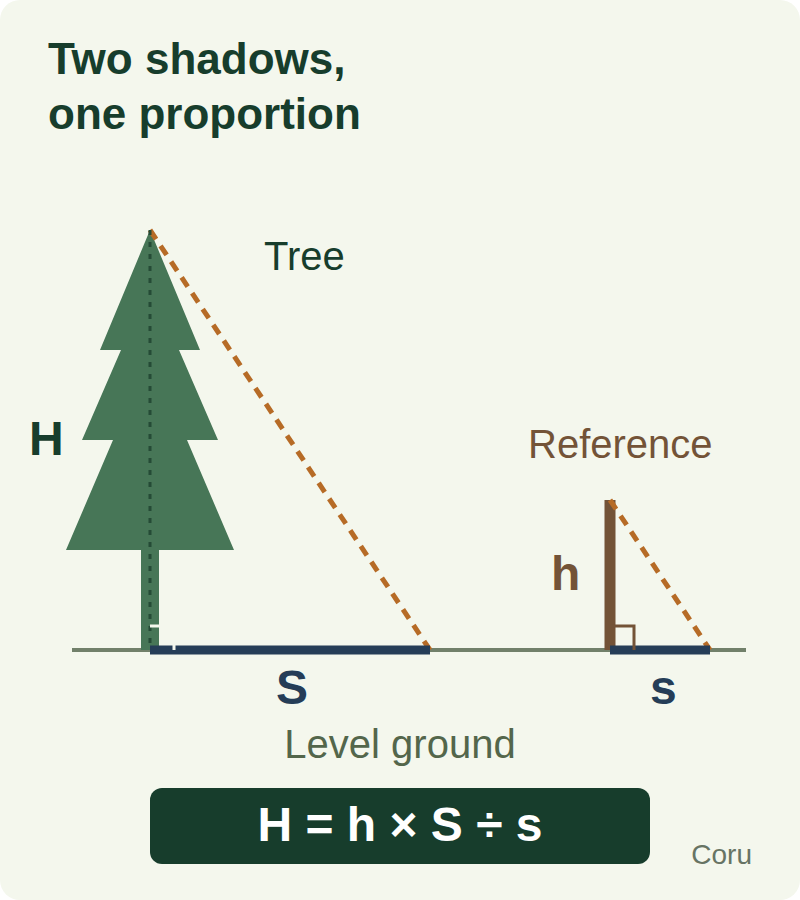
Invented example: a tree about 13 metres tall
Suppose the reference is 1.20 m tall, its shadow is 0.80 m long and the tree’s shadow is 8.40 m long, recorded together on level ground. These numbers illustrate the calculation; they are not field observations.
H = 1.20 × 8.40 ÷ 0.80 = 12.6 m. You could record “about 13 m; calculated value 12.6 m” alongside the three measurements. A calculator result alone does not justify claiming accuracy to the nearest centimetre.
To see the effect of a small difference, keep h and S unchanged: if s is actually 0.78 m, the calculation gives about 12.9 m; if s is 0.82 m, it gives about 12.3 m. Two centimetres in the small shadow therefore change this result by about 30 cm. This check isolates one source of error; it is not a complete error margin.
Copy this field worksheet
text
Date, time and tree location:
Clear, level ground: yes / no / uncertain
Treetop and its shadow tip identifiable: yes / no
Chosen unit:
h — reference height:
s — reference shadow:
S — tree shadow:
H = h × S ÷ s:
Second complete reading: h =       s =       S =       H =
Difference between estimates:
Observed limitations and result to keep:
Keep the raw measurements alongside the result. A note saying “cannot measure: shadows overlap” is more useful than a number with no clear basis.
Repeat a pair, then compare
Move the reference if its shadow was poorly placed, then repeat all the necessary measurements. The shadows may have changed: each calculation needs its own pair. Compare the two height estimates even if the shadow lengths differ.
If the results differ greatly, first check for a misplaced base point, a tilted reference, mixed units or an ambiguous shadow tip. Do not simply average away the problem. Two close results make the repeat consistent, but do not remove an error shared by both attempts.
When to leave the calculation aside
This estimate suits a nature notebook and a proportions exercise. It cannot determine tree-felling, pruning or safety clearances. Those decisions need an appropriate assessment by a competent person.
- Sloping ground, a mound, a dip or a shadow running up a wall: the horizontal model used here no longer matches the situation.
- A leaning trunk or a clearly offset crown: the top is not vertically above the starting point, so the distance from the base is not the required triangle’s horizontal side.
- A shadow that is too short, very fuzzy, interrupted or mixed with other shadows: its endpoints cannot be measured clearly enough.
- Wind moving the treetop, cloud hiding the shadow or measurements taken too far apart: wait for clearer conditions or choose another activity.