Leaf or leaflet? How to recognise a compound leaf
A group of green blades can be several leaves or the leaflets of one compound leaf. Start where the whole structure joins the twig: a visible axillary bud helps mark the base of a leaf. Then try four examples, including one that does not provide enough evidence.
First, find the twig
Look at a leafy twig from a tree or shrub, or use the drawings on this page. Follow a blade back towards the twig. Does it have its own attachment to the twig, or does it join other blades on one shared leaf stalk?
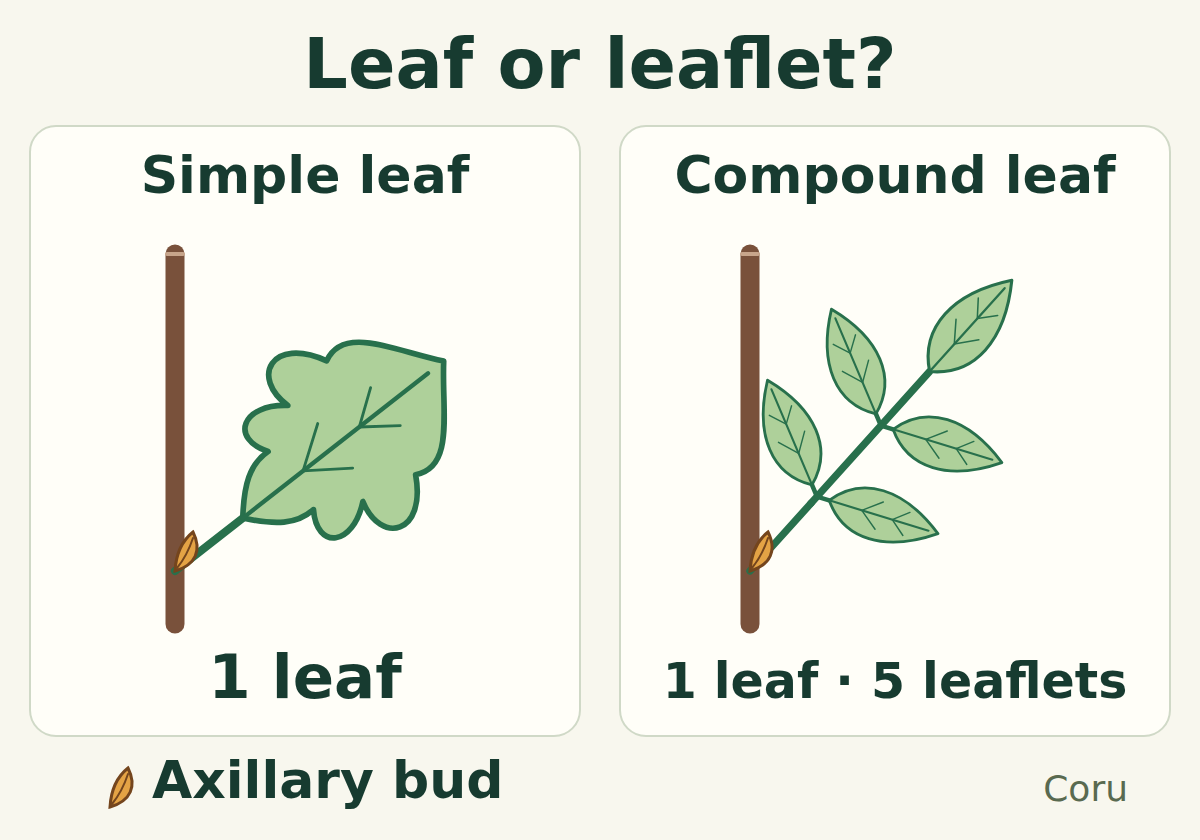
The flat, expanded part is the blade. A simple leaf has one continuous blade; deep lobes can still be parts of that one blade. A compound leaf is divided into separate leaflets. The stalk connecting a whole leaf to the twig is the petiole. In the feather-shaped compound example below, the axis carrying the leaflets is the rachis.
Kew and the American Museum of Natural History explain this distinction using the structure of the blade. Size is not the test: a small blade might be a leaflet, or it might be a small simple leaf.
Look at the attachment, then trace the whole leaf
An axillary bud sits in the angle just above the junction of a leaf and the twig. When you can see it, it helps locate the base of the whole leaf. There is no axillary bud at the junction of a leaflet and its rachis. This is the useful distinction explained by NC State Extension.
From one leaf attachment, trace outwards. One blade means a simple leaf in these examples. Several separate blades on that same leaf structure are leaflets. If each blade instead has its own petiole attached to the twig, with a bud in that axil, you are looking at several simple leaves.
Use a bud to locate an attachment; do not total every bud on the twig to count leaves. Buds also occur at shoot tips, and more than one can occur in a leaf axil. The brown twig, green stalks and enlarged orange buds in the drawings are teaching conventions, not a colour test for real plants.
Try four cases before reading the answers
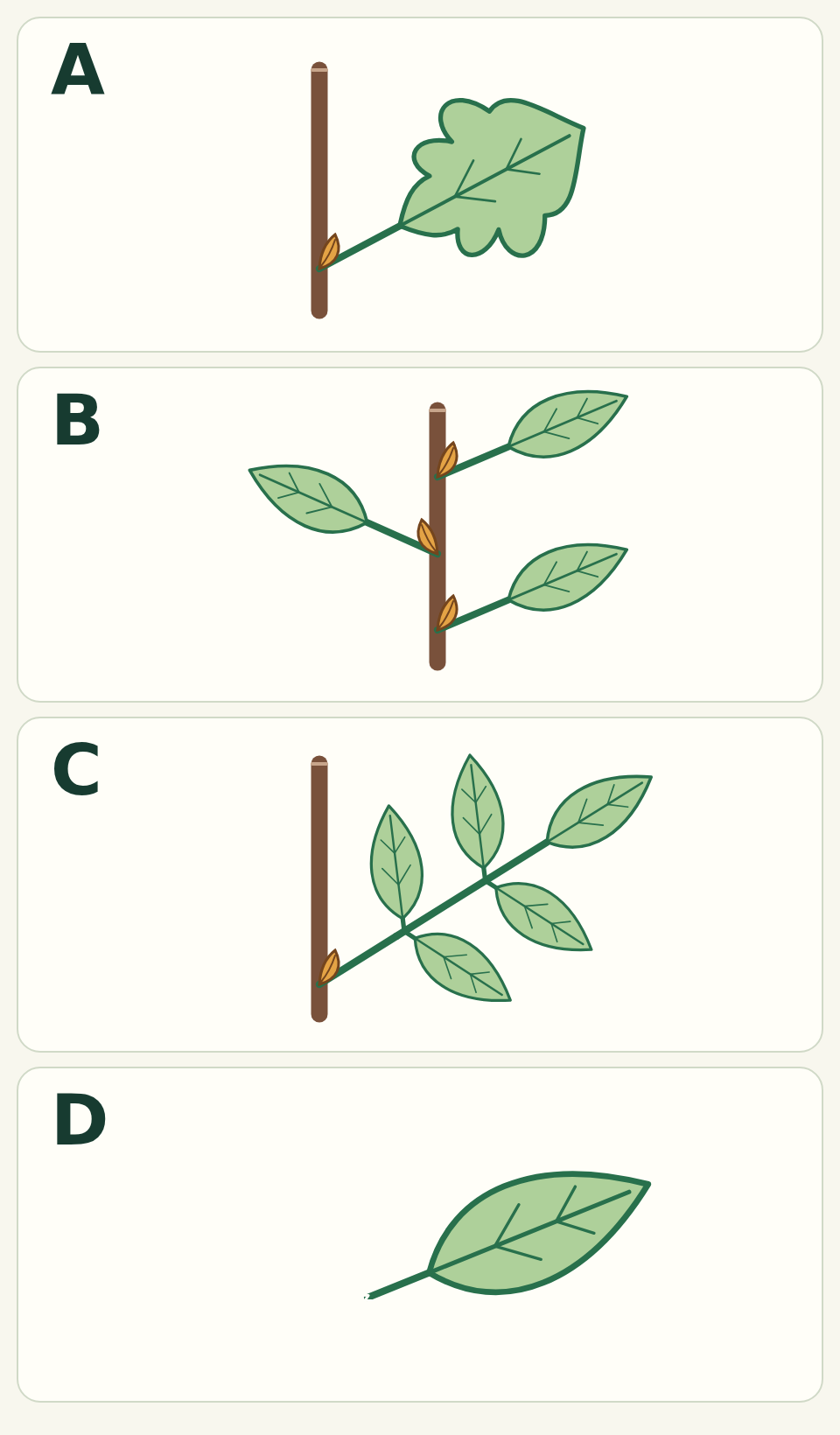
These are invented, simplified botanical diagrams, not portraits of named species. Count only the complete structures shown. For each case, decide how many whole leaves are shown and whether there are leaflets. “Cannot tell from this view” is an available answer.
The descriptions below give the same visual evidence in words. You can use them instead of the pictures.
- A. One lobed blade is connected by one stalk to a twig. A bud is visible just above that attachment.
- B. Three oval blades have three separate stalks. Each stalk joins the twig at a different point, with a bud just above its attachment.
- C. One stalk leaves the twig beside a bud. Farther out, it carries two pairs of separate blades and one blade at the tip. There are no buds at those five blade junctions.
- D. A detached oval blade has a short stalk. The picture does not show what that stalk was attached to.
Answers: trace the connections
- A — One simple leaf, no leaflets. Its lobes remain connected as one blade. Counting the lobes as separate leaves would split a single continuous structure.
- B — Three simple leaves, no leaflets. There are three separate leaf attachments on the twig. The shared brown structure is the twig, not the rachis of one leaf.
- C — One compound leaf with five leaflets. Two pairs plus the terminal leaflet make five. All five belong to the leaf whose petiole joins the twig beside the single drawn bud. Five blades do not mean five whole leaves.
- D — The drawing is insufficient. This could be a detached simple leaf or a leaflet from a compound leaf. Its outline and short stalk do not show which connection was lost. Ask to see the intact attachment on the plant or a photograph that includes it.
What if you cannot see a bud?
Keep the result open. A bud may be tiny, hidden or hard to distinguish at that stage of growth. Morgan Moeglein describes very small and camouflaged buds at Harvard’s Arnold Arboretum. Iowa State’s account of American sycamore (Platanus occidentalis) gives a concrete example: its buds are enclosed by the leaf-stalk base until the leaves fall.
So “I cannot see a bud here” is not enough by itself to prove “this is a leaflet”. Likewise, a fallen blade often loses the attachment clue. The Paleontological Research Institution explains the same difficulty for isolated fossil leaves and leaflets. Case D deliberately leaves that clue unavailable.
If leaves have already fallen, save this leaf-and-twig exercise for an intact leafy plant or a clear photograph. You do not need to peel, cut or detach anything to make an uncertain observation sound certain.
Try one observation outdoors
- Choose an intact leafy twig that you can see comfortably from a path or garden. Leave unknown plants in place; look or photograph without picking, tasting or pulling them apart.
- Frame the photograph widely enough to include the twig and the full leaf attachment, then take a closer view if a bud is visible. A photograph of the blade alone may remove the useful clue.
- Trace one leaf from its base to its tip. Record what is visible: for example, “one attachment to twig; five separate blades on a shared axis; bud visible at base”. This is a model note for case C, not a reported field observation.
- If the connection is hidden, record “attachment not visible” and stop there. You can try another accessible twig or return when the structure is easier to see.
What this tells you
You have practised separating a whole leaf from its leaflets, not identifying a tree. These common broad-leaf examples do not cover every leaf form. A plant name needs other features and an appropriate local guide; this exercise says nothing about whether a plant is edible.
The botanical distinction is established knowledge. Coru created these four diagrams, the count-and-explain exercise and its answer key. The useful result is a count you can explain from the attachment—or a clear statement of the missing clue.
Sources & further reading
- Kew Grow Wild — What leaves reveal about wildflowers
- American Museum of Natural History — Leaf Type
- NC State Extension — Botany: buds and leaves
- Iowa State University Extension — Sycamore
- Arnold Arboretum — Bud Morphology, Morgan Moeglein
- Paleontological Research Institution — Angiosperm leaf architecture, E. J. Hermsen