Winter turns the mirror in a reindeer’s eye blue
Summer gold. Winter blue. A tiny reflector behind a reindeer’s retina changes with the season. What could winter use to “repaint” it? Make a guess before looking inside.
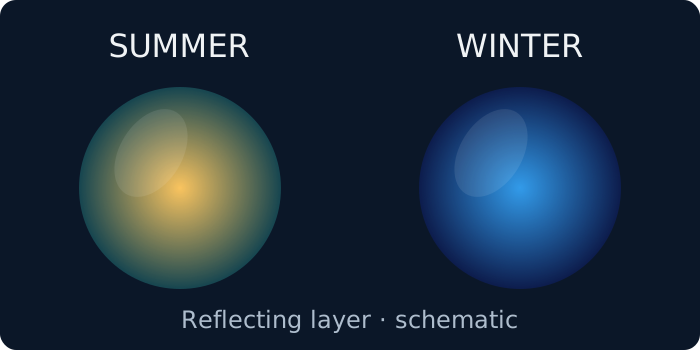
What could “repaint” this mirror?
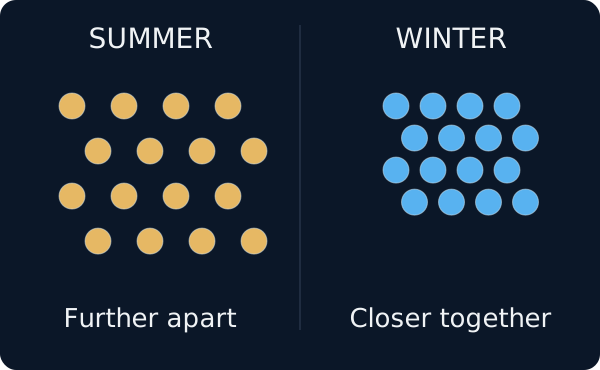
Studies link the blue reflection to a closer packing of collagen fibres. This is structural colour: the tissue’s reflective properties change. The effect does not require new blue pigment, and the eye does not begin to emit its own light.
Answers and explanations
- New blue pigment appears: In the studied reflector, colour is linked to the structure of collagen tissue. This explanation does not require new blue paint.
- Fibres pack closer together: Yes. Changing the spacing in the microscopic structure shifts the reflection towards shorter, blue wavelengths.
- The eye emits blue light: This is reflected incoming light, not light produced by the eye. With no incoming light, a mirror cannot create an image.
The mirror is at the back
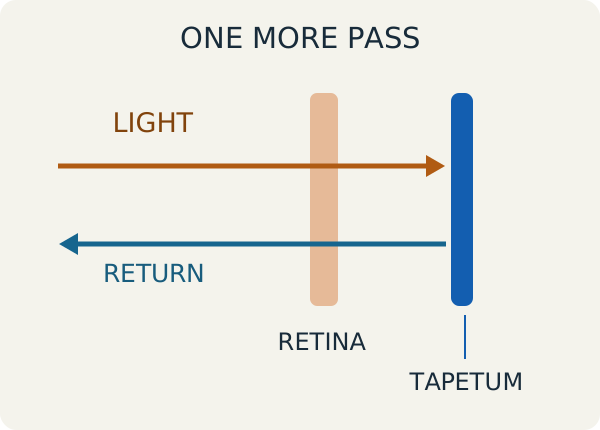
Look beyond the iris, the coloured ring around the pupil. Behind a reindeer’s light-sensitive retina sits the tapetum, a layer that sends some light back through it. Photons get another chance to be caught by light-sensitive cells. A similar reflector produces the familiar shine of a cat’s eyes in a torch beam.
A 2013 study compared reindeer eyes collected around the summer and winter solstices near Tromsø. The summer specimens had a mainly golden reflector; the winter ones were blue. Different animals supplied the specimens. This was not a year-long recording of one eye changing colour.
Colour without blue paint
The tapetum contains fine collagen fibres. Light reflects from their ordered structure, and the spacing affects which wavelengths are reflected most strongly. Researchers found closer packing in winter specimens.
In 2022, researchers tested this picture by watching the reflectance spectrum change as fluid slowly evaporated from specimens. Their proposed model links seasonal colour to the fluid between the fibres and the order of their packing. A tiny optical structure is being rearranged; no seasonal dye factory is needed.
What makes this happen in a living eye? One possible chain runs from a persistently dilated pupil in prolonged darkness, through altered fluid drainage and pressure inside the eye, to changes in the tapetum. Pressure and colour were measured. The whole causal chain remains an explanation to distinguish from the observation itself.
A blue winter is not a complete view of the world
A blue reflector fits the abundance of short-wavelength light in long northern twilight. It is tempting to finish the story there: the reindeer switches on a super-sensitive winter setting and sees everything better. But a mirror’s colour and an animal’s visual perception are different measurements.
A later review, first published online in 2024, accepts the seasonal shift in reflection but finds no conclusive evidence of a seasonal increase in absolute retinal sensitivity. It highlights a difficult comparison: a summer eye briefly adapted to darkness has not experienced weeks of winter adaptation. Electrical responses in a retina cannot, by themselves, reconstruct an animal’s perception either.
The remarkable part is real: a living mirror inside the eye changes colour. We can measure that reflection. Finding out what world it helps the reindeer see takes more than looking at the mirror.