Sunflowers stop following the sun. Then they all face east
Young sunflower plants follow the sun by growing faster on one side of the stem by day and the other by night, a rhythm driven by a circadian clock that keeps running in a chamber with a fixed light. As growth stops, the westward swing fades first and the heads freeze facing east, where they warm sooner and receive about five times more early-morning pollinator visits in field experiments. The article ends with three predictions a reader can test with a compass, and an honest list of what the studies do not settle.
A field at five in the afternoon
Stand at the edge of a sunflower field on a late-summer afternoon. The sun is low in the west and the heads are enormous, heavy and fully open. Now look at where they point. Not one of them is looking at the sun. Almost every head in the field faces the same way, with the sun on its back.
If you expected the flowers to turn with the sun, you are in good company. It is one of the most repeated facts about sunflowers, and it is half right. Young plants do track the sun, and they do it with a precision that is easy to miss until it is measured: by dawn, in midsummer or autumn, the shoot tips face fully east. Then they stop, and they stop in one particular position.
What is actually moving
A sunflower has no muscles and no joint. Some sun-following plants have small motor organs, called pulvini, that do the bending; a sunflower has none. The turning you can see in a young plant, before the flower opens, is growth, and it was measured directly by a team at the University of California, Davis, led by Stacey Harmer, with ink dots on the stem and a time-lapse camera.
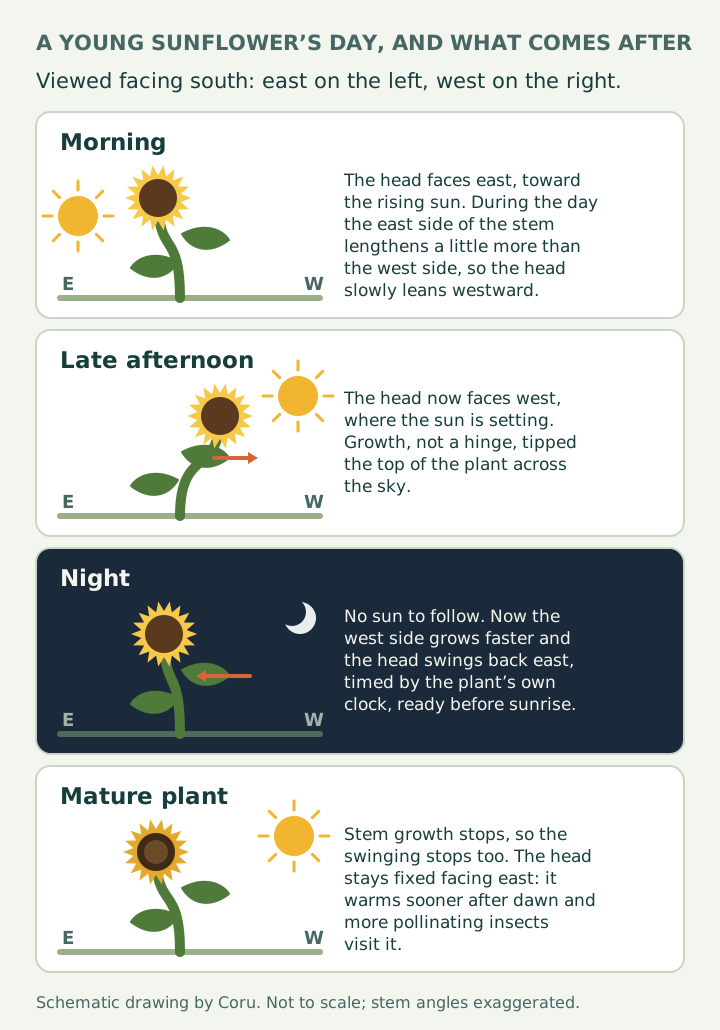
Through the day the east side of the stem lengthens a little faster than the west side. A stem that grows more on one side bends away from that side, so the top of the plant leans west, following the sun across the sky. At night the pattern flips: the west side grows faster, the stem straightens and overshoots, and by dawn the young head is facing east again, ready for sunrise.
That night-time return is the clue that something more than light is involved. There is no sun to follow in the dark.
A clock, not a reflex
The researchers took young plants that had grown outdoors into a growth chamber with a light fixed directly overhead. If the plants were simply bending toward the brightest light, the swinging should have stopped at once. Instead they kept swinging east and west for several days on the schedule they had learned outside, before the rhythm faded. A rhythm that continues without its cue is the signature of a circadian clock, the same kind of internal timer that makes you sleepy at the usual hour in a windowless room.
A second test made the same point from the other side. In a chamber where an arc of lamps switched on in sequence to imitate the sun's path, the plants followed the artificial sun and turned back at night as long as the day was 24 hours long. When the day was stretched to 30 hours, the night-time return became erratic. A clock built for 24 hours cannot keep time with a 30-hour day.
Light still matters: the plant has to know where the real sun is. But the obvious explanation turned out to be wrong here too. Most plants bend toward light using a blue-light sensor called phototropin, and plant scientists assumed that sun tracking was the same reflex. In 2023 the same laboratory found that the genes switched on in a stem bending toward a blue lamp indoors are largely not the genes active in a stem tracking the sun outdoors, and that filtering out blue light, or red and far-red light, did not stop field plants from tracking. Harmer's own summary was that the phototropin pathway seemed to be ruled out, with no clear replacement found yet.
What the swinging is for
Does the plant gain anything from all that bending? The team tested it the direct way. They tied some plants to stakes so they could not move, and turned others around every evening so that they faced west each morning. In repeated trials, plants that could not follow the sun ended up with roughly ten percent less dry weight and ten percent less leaf area than plants that could. A leaf that faces the sun catches more light over the day, and a young sunflower is in a hurry to build leaves.
Why they stop, and why they stop facing east
A sunflower keeps swinging only as long as its stem keeps lengthening. As the plant matures and the flower opens, elongation slows and then stops, and the daily swing shrinks with it. The decline is not symmetrical: day by day the head moves less and less to the west, yet each night it still returns to face east by morning. The last position the stem holds is the morning one. Once the stem stops lengthening, that is where the head stays, for the rest of the plant's life, whatever the sun does.
So the field at five in the afternoon is not ignoring the sun. It is frozen at dawn.
What east buys a flower
Facing east is not an accident the plant simply tolerates. It pays, and the payment can be counted. The researchers grew sunflowers in pots, and just before the petals appeared they turned half of the plants to face west. Infrared cameras showed the east-facing heads warming up faster in the morning. In those early-morning hours, pollinating insects visited the east-facing heads about five times as often as the west-facing ones, and the difference appeared only at the hours when the east-facing heads were actually warmer. When the team warmed west-facing heads with portable heaters until they matched, more insects came back, though still fewer than visited the heads facing east. Warmth is a large part of the attraction, but not the whole of it.
A follow-up study in 2021 found that east-facing heads also release their pollen earlier in the morning, when bees are already working, and that they fathered more seeds on neighbouring plants than west-facing heads did. In the California trials their seeds were about a fifth heavier; in trials in Virginia the seed difference disappeared, so that part depends on where the field is.
The direction itself is surprisingly exact on average. A Hungarian team photographed 2,800 mature heads in fourteen fields from a drone. Individual heads scattered widely, but their average direction was within half a degree of geographical east, which answered a question nobody had measured before: the heads do not point at the spot where the sun happened to rise that season, they point east.
Predict before you look
You can test the story with a compass app and a little patience. Make your prediction first, then check, and keep a note of the date, the time, the plant's stage and the direction: that is a small field record most people never make.
- A young plant, before the bud opens, after a whole day of heavy cloud. Will it still face east at dawn?
- A plant in full bloom, checked at noon and again at sunset. Will the head have moved?
- A mature plant that stands in the shade of a tree every morning. Will it face east like the rest?
The answers
- Probably yes, though nobody has published that exact test. The night-time return runs on the clock, and in the laboratory it carried on for days without any moving light; a day of flat grey cloud is a much weaker disruption than that.
- No. A head that has opened has stopped growing in length, and a stem that is not growing cannot bend. If it has moved, look for wind, a stake or a broken stem.
- Possibly not. In one Hungarian field, a group of heads that stood in tree shadow for about five hours after sunrise, and again before sunset, faced south instead of east. The clock sets the timing, but the light the young plant actually received shaped the direction it was left in.
What this does not tell you
These results come from the common sunflower, mostly from particular varieties grown at a few sites in California and Virginia, plus commercial fields in Hungary. The five-fold difference in insect visits was measured in the early morning in specific trials, consistent across years and sites with one bad-weather exception, and it is not a law for every field. The heavier seeds appeared at one site and not the other. Why east pays is also still argued: one line of work proposes that east-facing heads simply absorb the most light in regions where afternoons are cloudier than mornings, and the idea that prevailing winds push the heads east was tested against decades of wind data in 2025 and did not hold up. A plant on a windowsill leans toward the window for a different reason, and a head bent by wind or tied to a stake will not read the textbook. What the research does settle is the shape of the story: the swinging is growth timed by a clock, the stop is the end of growth, and east is where the clock leaves the head.
Sources & further reading
- Atamian et al. 2016, Circadian regulation of sunflower heliotropism, floral orientation, and pollinator visits, Science 353:587–590
- Creux et al. 2021, Flower orientation influences floral temperature, pollinator visits and plant fitness, New Phytologist 232:868–879
- Brooks et al. 2023, Multiple light signaling pathways control solar tracking in sunflowers, PLOS Biology 21:e3002344
- Kutschera & Briggs 2016, Phototropic solar tracking in sunflower plants: an integrative perspective, Annals of Botany 117:1–8
- Takács et al. 2022, Mature sunflower inflorescences face geographical east to maximize absorbed light energy, Frontiers in Plant Science
- Horváth et al. 2020, Sunflower inflorescences absorb maximum light energy if they face east and afternoons are cloudier than mornings, Scientific Reports
- Rajna et al. 2025, Regional prevailing wind directions cannot explain the global east facing of mature sunflower inflorescences, Planta
- UC Davis news, 2016: Sunflowers move by the clock
- UC Davis news, 2021: Why sunflowers face east
- UC Davis news, 2023: How sunflowers see the sun