They rearranged his stones. The bird restored the pattern.
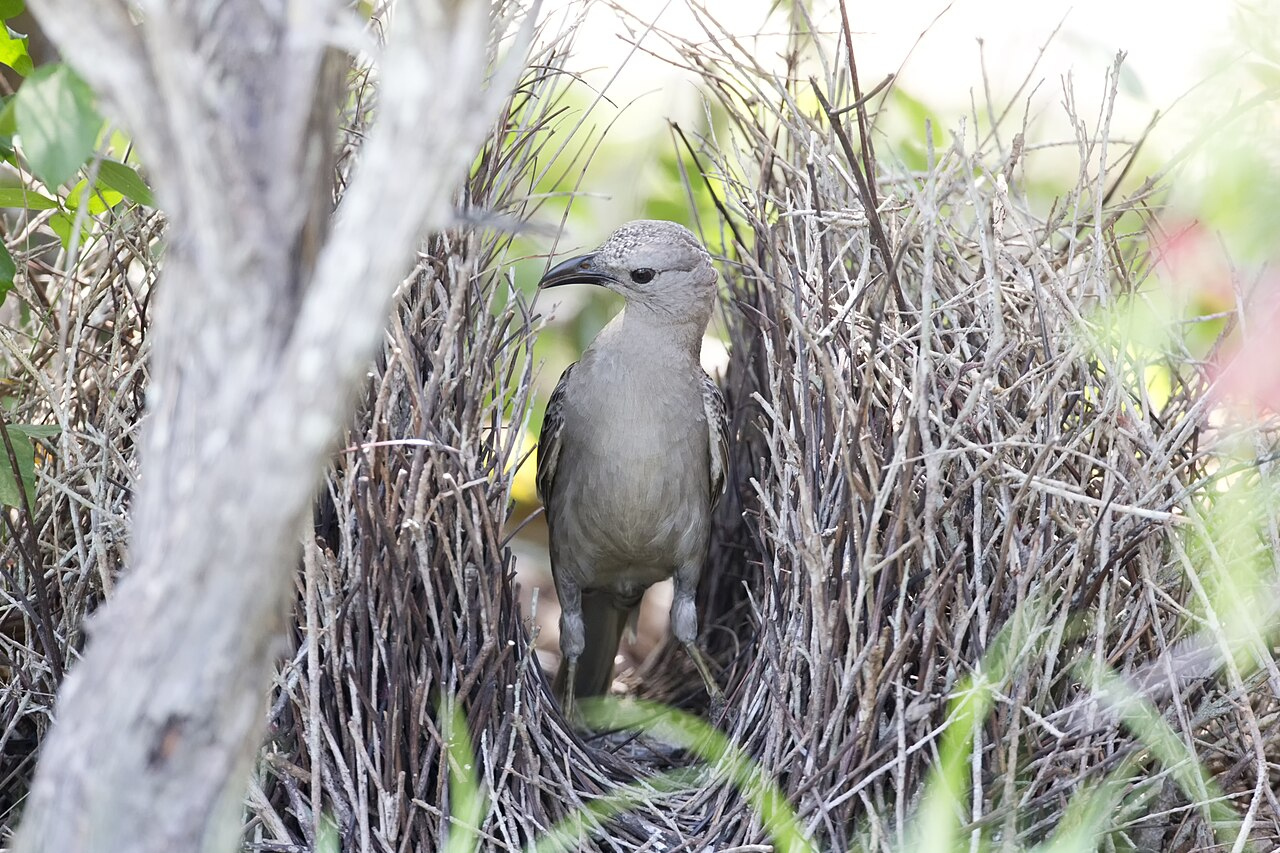
This display court has an audience’s seat. To understand the arrangement, look from there.
Please leave the set alone
Outside an avenue of twigs, a great bowerbird arranges stones, shells and bits of bone. The female looks over the court from inside the avenue. Try arranging different-sized objects for that particular viewpoint.
Rearrange four objects
Compare three arrangements. Check their sizes and distances in the table.
Which arrangement makes the four apparent widths equal?
An angular-width model. The circles on the right compare sizes, not the arrangement of stones.
All the same size
Same actual width, different apparent widths: distant objects look smaller.
| # | Distance | Width | Viewing angle |
|---|---|---|---|
| 1 | 1 | 0.35 | 19.85° |
| 2 | 2 | 0.35 | 10.00° |
| 3 | 3 | 0.35 | 6.68° |
| 4 | 4 | 0.35 | 5.01° |
Largest nearest
Putting the largest objects nearest makes the difference even greater.
| # | Distance | Width | Viewing angle |
|---|---|---|---|
| 1 | 1 | 0.56 | 31.28° |
| 2 | 2 | 0.42 | 11.99° |
| 3 | 3 | 0.28 | 5.34° |
| 4 | 4 | 0.14 | 2.01° |
Largest furthest
Different actual widths, equal apparent widths: the increase in size offsets distance.
| # | Distance | Width | Viewing angle |
|---|---|---|---|
| 1 | 1 | 0.14 | 8.01° |
| 2 | 2 | 0.28 | 8.01° |
| 3 | 3 | 0.42 | 8.01° |
| 4 | 4 | 0.56 | 8.01° |
Distances and widths use the same arbitrary unit.
This is an idealised model, not a reconstruction of a particular bower. Each object is compared separately at the centre of the view. The same four sizes are used in “Largest nearest” and “Largest furthest”. Only their order changes. Doubling both width and distance preserves the viewing angle. Real courts are less regular: the birds create a tendency, not four perfect rows.
Take the audience’s seat
Larger further away, smaller nearby: increasing size can offset distance. On actual great bowerbird courts, pale objects also tend to get larger with distance from the entrance. Their angular sizes, viewed from the avenue, are more even than with a random arrangement.
The male presents coloured objects over this court. The pale scattering forms a backdrop for his display. From above, the different sizes stand out; the audience at the entrance gets another view.
The experiment: reverse the pattern
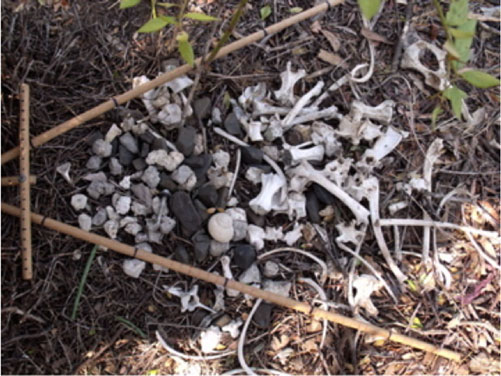
In a study published in 2010, researchers reversed the courts’ size–distance gradients: large objects went nearer, small ones further away. The males restored their gradients within three days. Two weeks later, they differed little from the original gradients.
That does not mean every stone returned to precisely the same spot. What mattered was the relationship between size and distance. The researchers changed that pattern; the birds changed it back.
What if you remove everything?
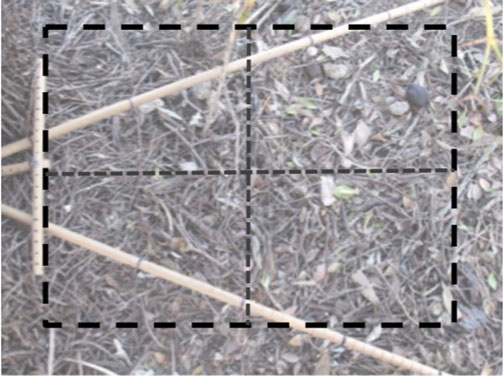
For another experiment, published in 2017, researchers moved the court objects to one side and recorded the rebuilding. They obtained usable measurements of the first ten returned objects at ten males’ bowers. All ten already showed the positive size–distance gradient at this early stage.
The birds did not begin with an unordered heap and sort it afterwards. The pattern emerged as they placed objects. But “the first ten” does not mean ten objects make a finished court: it describes an early measured stage of construction.
Geometry, without a proven mental blueprint
These experiments show that the birds build and restore an arrangement that creates forced perspective. They do not establish that a bird understands the angle formula or consciously intends to trick a female. A simple placement rule, a learned template and other mechanisms could produce similar behaviour.
Still, the pale scattering outside the entrance no longer looks quite like random debris. The researchers disturbed its pattern. The owner got on with the repairs.
